Due Date Calculator
Estimate your baby's due date and current pregnancy week from your last period, ovulation, conception, or ultrasound.
How to Use a Due Date Calculator
Choose the date you know, add any requested details, and review one consistent estimate.
- 1
Choose a Dating Method
Select last period, ovulation date, conception date, or ultrasound, then enter the corresponding date and any gestational age shown on an ultrasound report.
- 2
Check Cycle Length for the Last-Period Method
If you selected last period, keep the 28-day default or enter your usual cycle length. Longer cycles generally move the estimate later, while shorter cycles move it earlier.
- 3
Review and Confirm the Estimate
View the estimated due date, current pregnancy week, and timeline, then confirm the dating information with your doctor.
Why Use This Due Date Calculator
Quick pregnancy dating with cycle-based context and clear next steps.
-
Estimates a Pregnancy Due Date Fast
This calculator uses the common 40 week pregnancy rule from the first day of your last period. It gives one estimate, plus enough context to understand why timing can shift.
-
Connects Due Date to Ovulation Timing
A pregnancy estimate based only on a 28 day cycle can miss timing for longer or shorter cycles. This tool explains how ovulation timing changes the estimate.
-
Helps Plan Pregnancy Milestones
Once you have an estimate, you can review pregnancy weeks, trimester changes, and term milestones. Use our conception calculator to work backward from a known due date.
Quick Tips
Most estimates count 40 weeks from your last period
Standard pregnancy dating counts 280 days from the first day of the last menstrual period. That is why an LMP-based estimate asks for bleeding start timing before anything else.
Conception-based dating usually adds 266 days
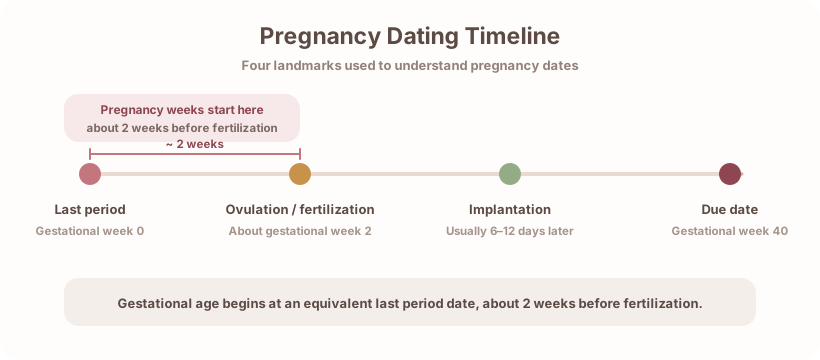
Conception-based dating uses a different anchor. If you know the conception day, the usual estimate is conception plus 266 days, because fertilization happens about 2 weeks after LMP in a 28 day cycle.
Ovulation-based dating can help with longer cycles
Ovulation-based dating adds about 266 days to ovulation. If your cycles are 32 or 35 days, this can fit better than the default 28 day assumption. Our ovulation calculator can help estimate that date.
Few babies arrive on the estimated due date
The estimate is a reference point, not a promise. Many births happen in the 2 weeks before or after that point. Call your doctor if you have bleeding, pain, fever, or reduced fetal movement later in pregnancy.
Sources
- Methods for Estimating the Due Date, American College of Obstetricians and Gynecologists (ACOG)
- Definition of Term Pregnancy, American College of Obstetricians and Gynecologists (ACOG)
- Fertility Awareness-Based Methods of Family Planning, American College of Obstetricians and Gynecologists (ACOG)
Due Date Questions
- Pregnancy dating estimates the end of a 40 week pregnancy. The most common method starts with the first day of your last menstrual period, then adds 280 days. That method assumes ovulation happened about 14 days after bleeding started. If your cycle is longer or shorter than 28 days, the estimate may move by a few days. This calculator uses your period date and cycle length as the starting point. If you know ovulation or conception timing, an estimate based on either date may fit better.
- To calculate due date from your last period, start with the first day of your last menstrual period and add 280 days, or 40 weeks. For example, if your last period started on January 1, the estimated due date would be around October 8 in a non-leap year. This is called LMP dating, and an LMP-based estimate uses the same rule. If your cycles are longer than 28 days, ovulation may happen later, so the result may need a small adjustment.
- This calculator gives an estimate, not a fixed delivery day. For regular 28 day cycles, the result can be useful for early planning, but many babies arrive before or after the estimated date. First trimester ultrasound is often used to confirm dating because early fetal size follows a predictable pattern. Use the result for planning, then let your doctor confirm the clinical estimate.
- Yes. Conception-based dating usually adds 266 days to conception. This can work if you know the likely conception timing from tracking, treatment, or one clear window. It is less certain if sex happened on several days in the fertile window, because sperm can live up to 5 days and the egg usually lives 12 to 24 hours. If you are still estimating conception from cycle timing, compare this estimate with our fertility calculator to narrow the window.
- Ovulation-based dating estimates the due date by adding about 266 days to ovulation day. This can be useful for people with longer cycles, shorter cycles, or ovulation test data. For example, if ovulation was on January 15, the estimated due date would be around October 8. That method often fits better than LMP dating when ovulation did not happen on cycle day 14. If you do not know ovulation day, use the cycle length in this calculator first, then check the ovulation estimate.
- The due date is the estimated day a pregnancy reaches 40 weeks of gestational age. Gestational age describes how far along the pregnancy is now, counted in weeks and days from an actual or equivalent last-period date. This calculator shows both values and places trimester and term milestones on the same dating timeline.
- This tool can still give a rough estimate with irregular periods, but the margin of error is wider. If cycles vary by more than 7 days, ovulation may also shift by a week or more. In that case, LMP dating can be off. Enter your best average cycle length in the calculator, then talk with your doctor about ultrasound dating. Early ultrasound, often in the first trimester, can help confirm gestational age when period dates are unclear.
- Yes. Our conception calculator starts with an estimated due date and works backward to estimate fertilization timing, a possible intercourse window, and an equivalent last-period date. Because the due date is an estimate, the dates calculated from it are estimates too.
- Yes. IVF dating uses embryo transfer timing and embryo age, not the usual LMP rule. A day 5 embryo transfer often uses transfer timing plus 261 days. A day 3 transfer often uses transfer timing plus 263 days. That is why an IVF-specific calculator is better for IVF, FET, donor egg, and embryo transfer cycles. This tool is meant for last period, ovulation, conception, or ultrasound-based estimates. For treatment cycles, use an IVF-specific tool or follow your clinic's date.
- Call an obstetric provider after a positive pregnancy test to ask when they want your first visit. Many offices schedule an early visit around 6 to 10 weeks, depending on history, symptoms, and local practice. The result can help you explain your LMP timing and estimated pregnancy week. Seek urgent care sooner for heavy bleeding, severe one-sided pain, fainting, fever, or shoulder pain. Online dating tools are for planning, not diagnosis.
Related Pregnancy Calculators
Keep exploring your cycle with these free tools.