Period Phase Calculator
Find out which phase of your menstrual cycle you're in right now.
How to Find Your Period Phase
Enter your cycle details and see your period phase in seconds.
- 1
Enter Your Last Period Start Date
Pick the first day of your most recent period. This is day one of period bleeding, not spotting. This date is the anchor point the period phase calculator uses to figure out where you are in your cycle right now.
- 2
Set Your Cycle Length
Type in your average cycle length. Most period cycles run 21 to 35 days, with 28 days being common. If unsure, count the days from the first day of one period to the first day of the next. Average your last few period cycles for a better number.
- 3
See Your Current Period Phase
Click calculate. This period phase calculator shows which of the four phases you are currently in, how many days you have been in that period phase, and when the next phase begins. No account needed, no app download required.
Why Use This Period Phase Calculator
Simple inputs, clear period phase breakdown, any cycle length.
-
Tells You Which Period Phase You're In Right Now
This period phase calculator figures out your current menstrual cycle phase based on your last period date and cycle length. You get a clear answer: menstrual, follicular, ovulatory, or luteal phase. Not a vague guess. A specific period phase with estimated dates.
-
Maps All Four Period Phases with Calendar Dates
Beyond your current period phase, this calculator maps the full cycle: when each phase starts and ends. Menstrual, follicular, ovulatory, and luteal phases all shown with actual calendar dates. Use the period phase calendar view to plan around your cycle.
-
Works for Any Period Cycle Length
Cycles run anywhere from 21 to 35 days, and this menstrual cycle phase calculator adjusts automatically for any length. Shorter period cycles mean shorter follicular phases. Longer cycles shift ovulation later. Enter your actual cycle length and the period phase math takes care of itself.
Quick Tips
The four period phases don't split your cycle equally
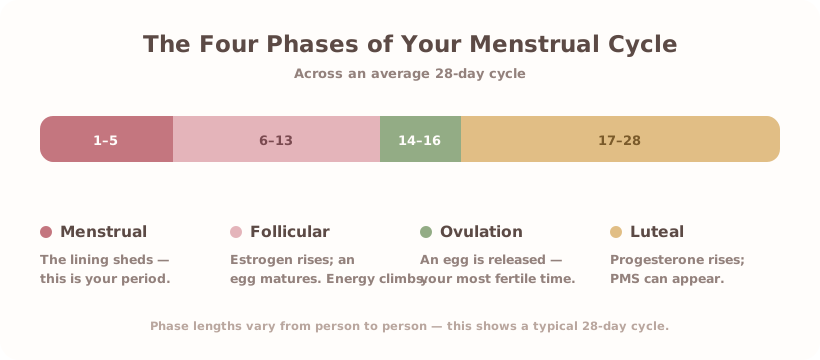
The menstrual phase lasts 3-7 days. The follicular phase overlaps with menstruation and runs until ovulation, usually days 1-13 for a 28-day period cycle. The ovulatory phase is short, just 1-2 days around ovulation. The luteal phase fills the rest, roughly days 15-28. A period phase calculator accounts for all this based on your specific cycle length.
Your luteal phase stays more consistent than your follicular phase
Most people have a luteal phase of about 12 to 16 days, though it can be shorter or longer, and it tends to stay stable period cycle to period cycle. The follicular phase is where most variation happens. This is why stress, illness, or travel can shift ovulation timing but usually won't change how long you feel PMS symptoms before your period arrives.
Period phase affects energy, mood, and physical performance
During the follicular phase, rising estrogen typically boosts energy and mood. The ovulatory phase brings peak energy for many people. The late luteal phase, the week before your period, can bring fatigue and mood shifts as progesterone rises then falls. Knowing your period phase helps explain why you feel different at different points in your cycle.
Track a few period cycles to improve predictions
This period phase calculator uses your average cycle length. If your period varies by more than 3-4 days month to month, averaging over 3 period cycles gives better results. For example, if your last three period cycles were 26, 29, and 28 days, use 28 as your input to this period phases calculator.
Sources
- Menstrual Cycle (Normal Menstruation): Overview & Phases, Cleveland Clinic
- Luteal Phase Of The Menstrual Cycle: Symptoms & Length, Cleveland Clinic
- Variability in the phases of the menstrual cycle, Journal of Obstetric, Gynecologic, & Neonatal Nursing
- The effects of menstrual cycle phase on exercise performance in eumenorrheic women: a systematic review and meta-analysis, Sports Medicine (2020)
- Heavy periods, NHS
Period Phase Calculator FAQ
- A period phase calculator works by taking your last period start date and average cycle length, then estimating when each phase begins and ends. Day 1 is the first day of your period. The menstrual phase runs from day 1 until period bleeding stops, typically 3-7 days. The follicular phase starts on day 1 and runs until ovulation, covering days 1-13 on a 28-day period cycle. Ovulation happens around day 14. The luteal phase fills the remaining days until your next period. To figure out which period phase you're in now, count the days since your last period started and match that number to the phase ranges for your cycle length.
- Count the days since your last period started. That day count tells you your current cycle day. For a standard 28-day period cycle: days 1-5 are the menstrual phase, days 6-13 are the follicular phase, days 14-15 are the ovulatory phase, and days 16-28 are the luteal phase. For a longer 32-day period cycle, ovulation shifts later, around day 18. For a shorter 25-day period cycle, ovulation comes earlier, around day 11. This period phase calculator does this math for your specific cycle length, so you don't have to estimate manually.
- The 7-2-1 rule flags possible heavy menstrual bleeding: bleeding for more than 7 days, needing to change a pad or tampon every 2 hours or less or passing clots larger than 1 inch. Talk with a healthcare professional if these apply to you. This rule does not describe menstrual cycle phases.
- The four phases of the menstrual cycle are: (1) Menstrual phase, when period bleeding occurs, typically 3-7 days. (2) Follicular phase, starting on day 1 of your period and continuing until ovulation. During this phase, follicles in the ovaries mature and estrogen rises. (3) Ovulatory phase, the 1-2 day window when a mature egg is released. Estrogen peaks just before ovulation and triggers the LH surge. (4) Luteal phase, from ovulation until your next period. The empty follicle produces progesterone to prepare the uterine lining. If fertilization doesn't happen, progesterone drops and your period begins. You can use our cycle phases calculator to see the exact dates for each phase in your period cycle.
- Period phase lengths depend on your overall cycle length. For a 28-day period cycle, the follicular phase starts on day 1, overlaps with menstruation and continues until ovulation around day 14. The luteal phase follows ovulation and often lasts about 12 to 16 days, though its length varies. The luteal phase is the most consistent across different period cycle lengths. What changes is mainly the follicular phase. With the default 14-day luteal phase, this calculator estimates a follicular phase of about 7 days for a 21-day cycle. For a 35-day cycle, it estimates about 21 days. This is why ovulation can happen anywhere from day 7 to day 21 depending on your period cycle length.
- Delayed ovulation can make a period arrive later than expected. You may still be in the follicular phase if ovulation has not happened, or in the luteal phase if it happened later than usual. Stress, illness, significant weight changes, and travel can all delay ovulation and shift period phase timing. Take a pregnancy test from the first day of a missed period to rule that out first. Keep in mind that this period phase calculator estimates based on a regular average cycle length. For tracking purposes, use your next period start date to recalibrate the phase calculations.
- Yes, with some adjustment. If your period cycles vary in length, find your average. Take your last 3-4 period cycle lengths and average them. For example, period cycles of 24, 28, 30, and 26 days average to 27 days. Enter 27 as your cycle length in this period phases calculator. The prediction will be a reasonable estimate rather than exact. For very irregular period cycles, combining this calculator with an ovulation calculator and ovulation predictor test strips can help you track your actual phase timing more accurately.
- Not necessarily. Period length and fertility are separate things. A short menstrual phase of 2-3 days doesn't automatically indicate a fertility issue. What matters more is whether ovulation is happening regularly across period cycles. Some people have consistently short periods and ovulate normally. However, if periods are very light and short alongside difficulty conceiving, it's worth discussing with a doctor. For a clearer picture of your fertile window within your period cycle, use our fertility calculator alongside this period phase calculator.
- The follicular phase starts on day 1 of your period and runs until ovulation. During this phase, follicle-stimulating hormone (FSH) signals several follicles in the ovaries to start maturing. One follicle becomes dominant and produces increasing estrogen. Rising estrogen rebuilds the uterine lining after your period and eventually triggers an LH surge that causes ovulation. Energy and mood often improve during the follicular phase as estrogen rises. By the end of this phase, just before ovulation, estrogen reaches its period cycle peak. The follicular phase calculator can show you the exact dates for this phase in your period cycle.
- A 2020 meta-analysis found that exercise performance might be slightly lower in the early follicular phase, but the evidence was mostly low in quality and varied across studies. The early luteal phase may still support performance. The late luteal phase, the week before your period, tends to bring increased fatigue for many people. Core body temperature also rises slightly after ovulation, which can affect heat tolerance. Knowing your period phase helps you plan higher-intensity training for your follicular and ovulatory phases and schedule more recovery during the late luteal phase before your period returns.
More Period Phase Calculator Tools
Keep exploring your cycle with these free tools.