Period Cycle Calculator
Predict your next period date and understand your menstrual cycle in seconds.
How to Calculate Your Period Cycle
Three inputs. Instant prediction. No account needed.
- 1
Enter Your Last Period Start Date
Pick the first day your most recent period started. Use the actual start of bleeding, not spotting. This date is the anchor for your period cycle calculation. Getting it right is what makes the prediction accurate.
- 2
Set Your Average Cycle Length
Most people have cycles between 21 and 35 days. The textbook average is 28 days, but your personal average may differ. If you track regularly, use your actual average. If you're just starting out, use 28 and adjust after a few cycles.
- 3
Get Your Predicted Next Period Date
Click calculate. This period cycle calculator shows your predicted next period start date plus how many days remain. No waiting, no email signup, no app download needed.
Why Use This Period Cycle Calculator
Accurate predictions for any cycle length, regular or not.
-
Predicts Your Next Period Date
This period cycle calculator adds your average cycle length to your last period start date to predict when your next period begins. For people with consistent cycles, predictions usually land close to the actual date. You get a specific date, not a vague range.
-
Works for Any Cycle Length
Short 21-day cycles, longer 35-day cycles, anything in between: this monthly period cycle calculator adjusts automatically based on your input. For irregular periods, enter an average of your last 3-6 cycle lengths. The calculation stays the same regardless of your pattern.
-
Shows Days Until Your Next Period
Beyond just the date, this period cycle length calculator counts down exactly how many days remain. Useful for planning around travel, events, or activities. Knowing your cycle means fewer surprises.
Quick Tips
Cycle length is measured from period start to period start
Count the days from day 1 of one period to day 1 of the next period. Many people mistakenly count from the end of their period to the start of the next. That error adds 3-7 days to the calculated cycle length and throws off all future predictions.
Normal cycle length ranges from 21 to 35 days
The 28-day average is a population statistic, not a target. The Office on Women's Health says a normal cycle lasts 24 to 38 days, while ACOG gives 21 to 35 days. A cycle that arrives consistently at 26 days or 32 days is normal. What matters is consistency within your own pattern.
Cycle length varies slightly from month to month
A variation of a few days between cycles is typical. Variations up to 7 days are still within a broad normal range. Stress, illness, travel, and significant weight changes can all shift when you ovulate, which shifts when your period arrives. Track several menstrual cycles before drawing conclusions about your average.
Use 3-6 months of data for the most accurate prediction
One or two period cycles may not reflect your true average. After tracking 3-6 cycles, add up all the cycle lengths and divide by the count to get your real average. Enter that number into this period cycle calculator for better accuracy over time.
Sources
- Abnormal Uterine Bleeding, American College of Obstetricians and Gynecologists (ACOG)
- Your menstrual cycle, Office on Women's Health, U.S. Department of Health and Human Services
- Variability in the phases of the menstrual cycle, Journal of Obstetric, Gynecologic & Neonatal Nursing (2006)
- Doing a pregnancy test, NHS
Period Cycle Calculator FAQ
- Count the number of days from the first day of one period to the first day of the next. That count is your cycle length. For example, if your last period started February 1st and the one before that started January 4th, your cycle length is 28 days. Repeat this for 3-6 months and average the numbers. Then enter your most recent period start date and that average cycle length into this period cycle calculator. The tool adds your cycle length to your last period start date to predict when your next period arrives.
- Your next period arrives based on your full cycle length, counted from your last period start date, not from when bleeding stopped. If your cycle is 28 days and your period lasted 5 days, your next period starts 23 days after your previous period ended. For a 30-day cycle with a 5-day period, that is 25 days after bleeding stopped. The period cycle calculator counts from your last start date because that is the consistent measurement point. Period length itself can vary from month to month, but cycle length stays more stable.
- Track your period start dates for at least 3 consecutive months to find out. Write down day 1 of each period. Count the days between consecutive start dates. Average those numbers. That is your personal cycle length. The 28-day cycle appears in textbooks as a population average, but the Office on Women's Health says cycles of 24 to 38 days are normal, while ACOG gives 21 to 35 days. Using the wrong number in a period cycle calculator produces predictions that are consistently off in the same direction, so taking time to find your real average is worth it.
- Pregnancy is possible 2 days after a period ends, even with a 28 to 30 day cycle. The risk depends on how long bleeding lasts and when ovulation occurs. Ovulation usually occurs around the midpoint of the cycle, roughly 14 days before the next period. For a 28-day cycle, ovulation falls around day 14, about 9 days after a 5-day period ends. However, sperm survive 3-5 days inside the body. If you have a short cycle of 21-24 days, ovulation can happen earlier, meaning the fertile window could overlap with the end of your period. Use an ovulation calculator alongside this period cycle calculator to understand your full fertile window.
- The American College of Obstetricians and Gynecologists defines a normal cycle length as 21-35 days. Cycles shorter than 21 days or longer than 35 days may be worth discussing with a doctor, especially if the pattern is new or accompanied by other symptoms. Teenagers and people close to the onset of menstruation often have more variable cycles and that is expected. Cycle length also tends to change and become more irregular during perimenopause. Tracking with a period cycle calculator over several months helps you establish your personal baseline.
- For people with regular cycles, a period cycle calculator is usually close to the actual date. Accuracy depends on two factors: how consistent your actual cycle length is, and how precisely you record period start dates. If your cycle varies by 2 days each month, predictions will be off by up to 2 days. If your cycle varies by 7 days, the error range is similar. The calculator uses a fixed average, but biology is not perfectly fixed. Track multiple cycles and use your actual calculated average as the input to make this monthly period cycle calculator as reliable as possible.
- Record the first day of your period for at least 3 months. Count the days between each pair of consecutive start dates. Add those cycle lengths together and divide by the count. For 3 months of data, you have 2 cycle lengths. Add them and divide by 2. For 6 months of data, add 5 cycle lengths and divide by 5. That result is your average. Enter it into this period cycle calculator as your cycle length. Repeat the average calculation every few months since cycle lengths can shift with age, stress, and hormonal changes.
- For a menstrual cycle calculator for irregular periods, the approach is finding a working average. Gather your last 3-6 cycle lengths. Add them up and divide by the count. Use that average as your cycle length input. Predictions will have a wider error range than for consistent cycles, but the estimate still gives you a useful planning window. Combining this calculator with symptom tracking, like cramps, breast tenderness, or mood shifts, helps you recognize when your period is approaching even if the exact date shifts. Pairing it with a fertility calculator can also help you understand your full cycle.
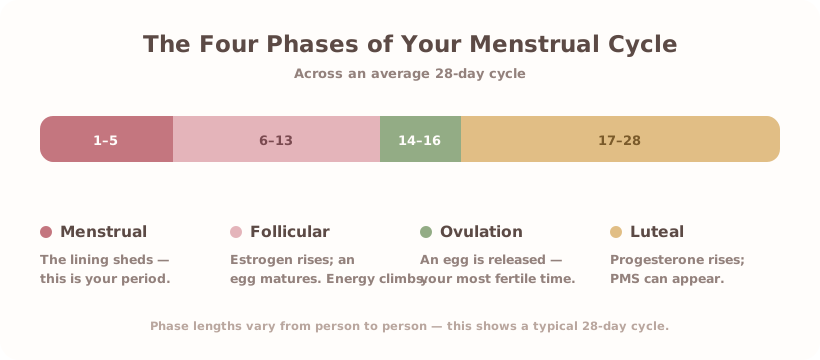
- Period length and cycle length measure two different things. Period length is how many days you bleed each month, typically 3-7 days for most people. Cycle length is the total number of days from one period start date to the next, typically 21-35 days. When you use a period cycle calculator, you enter your cycle length, not your period length. Entering your period length by mistake produces inaccurate predictions because it is much shorter than your actual cycle. Your period is one phase within your cycle, not the cycle itself.
- A period is usually called late when it has not started by the day you expected it. Being a few days late without other changes is usually not a concern. Take a pregnancy test from the first day of a missed period. If you do not know when your period is due, test at least 21 days after your last unprotected sex. If pregnancy is not the cause, common reasons include stress, illness, significant weight change, heavy exercise, and hormonal fluctuations. Tracking your cycle with this period cycle calculator over several months helps you recognize what late means for your own pattern versus what is genuinely unusual.
More Period Cycle Calculator Tools
Keep exploring your cycle with these free tools.