Conception Calculator
Estimate conception timing from the date you know.
How to Use the Conception Calculator
Start with the date you know, then review one consistent set of pregnancy-dating estimates.
Choose the Date Type You Know
Select estimated due date, last period, ovulation date, conception date, ultrasound date, or IVF transfer. The calculator opens on estimated due date by default.
Enter the Date and Requested Details
Fill in that date. Add cycle length for the last-period method, gestational weeks and days for ultrasound, or the documented embryo age for IVF.
Read the Dating Estimate
See estimated fertilization timing, possible intercourse dates when applicable, estimated due date, and current pregnancy week as of the selected date.
Refine LMP Estimates if Needed
Open Advanced options to adjust the luteal phase or enter up to three recent cycle lengths for a wider, cycle-based range.
What This Conception Calculator Can Do
Six starting points, transparent date math, and one private result experience.
Starts From Six Date Types
Calculate from an estimated due date, last period, ovulation date, conception date, ultrasound date with reported gestational age, or IVF transfer.
Uses One Result Model
Each method connects estimated fertilization timing, due date, pregnancy dating, and relevant milestones, with possible intercourse dates shown only when applicable.
Lets You Adjust the Luteal Phase
For an LMP estimate, Advanced options let you replace the 14-day luteal-phase default with a value that better matches your tracked cycles.
Builds a Range From Recent Cycles
Enter up to three recent cycle lengths to use their rounded average for the main LMP estimate and their shortest-to-longest span for date ranges.
Shows Its Calculation Assumptions
The result names the dating basis and displays the cycle, luteal-phase, ultrasound, or embryo-age assumptions used for that method.
Keeps Dates in Your Browser
The calculation runs on your device. Dates entered here are not uploaded, saved, or sent to a server.
Quick Tips
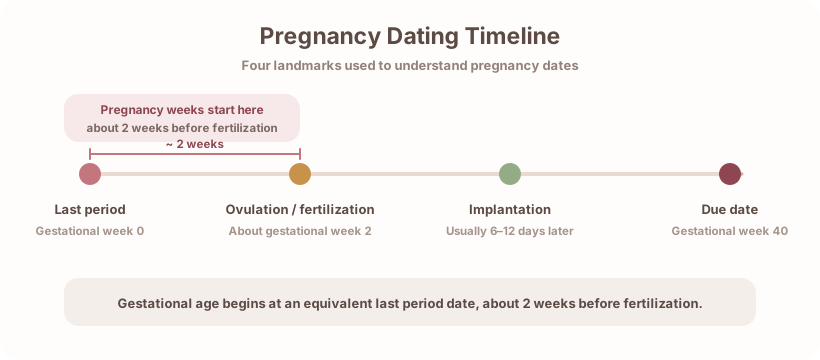
Pregnancy weeks begin before conception
Gestational age starts from an actual or equivalent last-period date, so the pregnancy count is usually about two weeks ahead of time since fertilization.
Intercourse and fertilization are different dates
Sperm can remain viable for several days, while the egg is available for about a day after ovulation. The possible intercourse range is therefore wider than the fertilization estimate.
Different anchors have different uncertainty
A due date, LMP, tracked ovulation date, reported ultrasound age, and IVF record provide different dating clues. Use the date documented by your care team for medical decisions.
Recent cycles can show timing variability
If cycle lengths change, enter up to three recent lengths under Advanced options. The calculator will show a range instead of hiding that variation.
Ultrasound mode converts report data
This calculator converts the gestational age printed on an ultrasound report into dates. It does not analyze an image or decide whether a clinical due date needs to change.
A conception date is not proof
Cycle math cannot prove paternity or the exact day sperm met egg. Treat every natural-conception result as a dating estimate.
Sources
- Methods for Estimating the Due Date — American College of Obstetricians and Gynecologists
- Fertility Awareness-Based Methods — American College of Obstetricians and Gynecologists
- Conception — Cleveland Clinic
Conception Calculator FAQ
Related Fertility and Pregnancy Calculators
Keep exploring your cycle with these free tools.