Ovulation Day Calculator
Find your estimated ovulation day and peak fertility window based on your cycle data.
How to Calculate Your Ovulation Day
Three inputs. Your ovulation day in seconds.
- 1
Enter Your Last Period Start Date
Select the first day your most recent period started. This means the day actual bleeding began, not spotting. Accurate input helps this ovulation day calculator give you a reliable result.
- 2
Set Your Average Cycle Length
Normal cycles range from 21 to 35 days. Use the +/- buttons to match your usual pattern. If you are unsure, 28 days is a good starting point. The calculator adjusts the ovulation day estimate based on your cycle length.
- 3
View Your Ovulation Day and Fertile Window
Click calculate. You get your predicted ovulation day plus the 6-day fertile window around it. No account needed, no email required.
Why Use This Ovulation Day Calculator
Estimate your ovulation day with simple cycle data.
-
Calculates Your Ovulation Day
This ovulation day calculator uses the luteal phase method to count backward from your expected next period. You get a specific date for your ovulation day, not a vague range.
-
Maps Your 6-Day Fertile Window
Knowing your ovulation day is half the picture. This calculator also shows the 5 days before it when sperm can survive and wait for the egg. All 6 fertile days appear in your results.
-
Adapts to Any Cycle Length
Cycles between 21 and 35 days are considered normal. This ovulation day calculator works for short, average, and long cycles. Enter your actual cycle length and the formula handles the rest.
Quick Tips
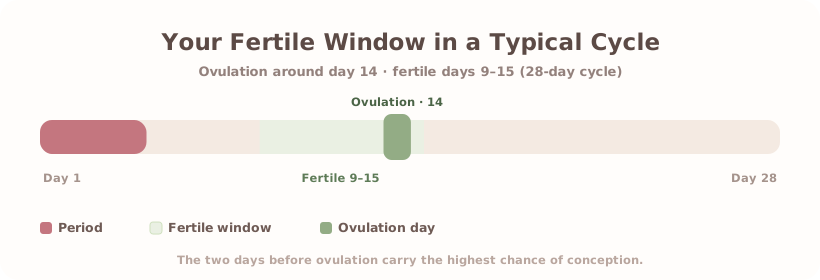
Your ovulation day falls about 14 days before your next period
The luteal phase (time between ovulation day and your period) often lasts about 12 to 16 days, though it can be shorter or longer. The first half of the cycle varies more. This is why the calculator counts backward, not forward.
The 2 days before ovulation day are your most fertile
While the fertile window spans 6 days, the highest pregnancy rates come from the 2 days right before ovulation day. Sperm that arrive early are already in position when the egg releases.
Ovulation day can shift from cycle to cycle
Stress, sleep changes, travel, and illness can all move your ovulation day earlier or later. Tracking several cycles with a period calculator gives you a clearer pattern over time.
Confirm ovulation day with physical signs
A rise in basal body temperature (about 0.5°F) after ovulation day confirms it happened. Cervical mucus also changes to a clear, stretchy consistency around egg release. Ovulation predictor kits detect an LH surge, which suggests ovulation may be approaching but does not confirm that an egg was released.
Sources
- Optimizing natural fertility: a committee opinion, American Society for Reproductive Medicine (ASRM)
- Fertility evaluation of infertile women: a committee opinion, American Society for Reproductive Medicine (ASRM)
- Timing of sexual intercourse in relation to ovulation. Effects on the probability of conception, survival of the pregnancy, and sex of the baby, New England Journal of Medicine (1995)
- Your menstrual cycle, Office on Women's Health, U.S. Department of Health and Human Services
Ovulation Day Calculator FAQ
- To calculate your ovulation day, start with the date your last period began and add your average cycle length. Then subtract 14 days. For a 28-day cycle starting January 1, your next period is due January 29, and your ovulation day falls around January 15. The 14-day subtraction represents the luteal phase, which often lasts about 12 to 16 days, though it can be shorter or longer. This ovulation date calculator does this ovulation day calculation automatically when you enter your dates.
- The highest chance of pregnancy is usually in the 2 days before ovulation. The fertile window spans the five days before ovulation and ovulation day. In Wilcox et al.'s 1995 study, estimated conception probability ranged from about 10% five days before ovulation to 33% on ovulation day.
- No single method gives 100% confirmation, but combining methods gets close. A blood progesterone test about 7 days after expected ovulation day (day 21 in a 28-day cycle) is one clinical option. At home, basal body temperature tracking shows a sustained rise of 0.5-1°F after egg release. Ovulation predictor kits detect an LH surge, which suggests ovulation may be approaching but does not confirm that an egg was released. Using this ovulation day calculator alongside LH strips and temperature tracking covers all angles.
- Yes, but accuracy drops with irregular cycles. If your cycles vary, average your last 3-6 cycle lengths and use that number in this calculator. For example, cycles of 26, 30, and 28 days average to 28. For cycles that swing by more than 7 days month to month, pair this ovulation day calculator with ovulation predictor kit strips. The calculator narrows down the approximate window and the strips show when an LH surge arrives. Our ovulation calculator works the same way and can help you cross-check results.
- On ovulation day, a mature egg releases from one of your ovaries into the fallopian tube. This follows a surge of luteinizing hormone (LH) that peaks about 24-36 hours before the egg drops. You may notice clear, stretchy cervical mucus similar to raw egg whites. Some people feel mild one-sided lower abdominal pain called mittelschmerz. Your basal body temperature rises slightly (0.5-1°F) within 24 hours after the egg releases. The egg survives only 12-24 hours, so the window for fertilization is short.
- Not always. Even with regular cycles, your ovulation day can shift from month to month. Factors like stress, poor sleep, intense exercise, illness, and weight changes can push egg release earlier or later. The luteal phase (after the egg drops) stays more stable than the follicular phase (before it). This is why tracking multiple cycles with a fertility calculator gives you a more accurate picture than relying on a single calculation.
- The gap between your period and ovulation day depends on your cycle length. For a 28-day cycle, ovulation day typically falls around day 14, so about 9-10 days after a 4-5 day period ends. For a shorter 24-day cycle, it may come as early as day 10, just 5-6 days after bleeding stops. For a longer 32-day cycle, it arrives around day 18. Use an ovulation date calculator or this formula: cycle length minus 14 equals your approximate ovulation period day number.
- Yes. The fertile window extends beyond ovulation day itself. Sperm survive 3-5 days inside the reproductive tract, so intercourse up to 5 days before egg release can lead to pregnancy. The egg lives 12-24 hours after it drops. This creates a 6-day window where pregnancy is possible. The highest odds fall on the 2 days before and the day of ovulation itself. After that window passes, the egg breaks down and you are unlikely to conceive until the next cycle.
- Cycle length directly determines your ovulation day. Longer cycles push it later: a 35-day cycle means egg release around day 21. Shorter cycles bring it forward: a 21-day cycle means day 7. The key is that the luteal phase (from egg release to next period) stays consistent at about 14 days, while the follicular phase (period to ovulation day) stretches or shrinks with cycle length. This ovulation day calculator accounts for your specific cycle length in its calculation.
- Both serve different purposes, and using them together works best. This ovulation day calculator gives you predicted dates based on your cycle history. It costs nothing and helps you plan ahead. Test strips detect actual hormone changes in real time. They show when an LH surge happens, which suggests ovulation may be approaching but does not confirm that an egg was released. A practical approach: use this ovulation day predictor to know when to start testing with strips, then let the strips show when a surge arrives. The calculator saves you from testing every single day of the month.
More Ovulation Day Calculator Tools
Keep exploring your cycle with these free tools.