Menstrual Cycle Calculator
Predict your next period and menstrual cycle dates in seconds.
How to Calculate Your Menstrual Cycle
Three inputs. Instant results. No account needed.
- 1
Enter Your Last Period Start Date
Pick the first day your most recent period actually began. That means the first day of real bleeding, not spotting. This date is the anchor for every calculation this menstrual cycle calculator makes.
- 2
Set Your Average Cycle Length
Most menstrual cycles run 21 to 35 days, with 28 days being the textbook average. If your cycle varies, add up your last three or four cycle lengths and divide. Enter that number. The calculator adjusts everything based on your input.
- 3
Get Your Predicted Period Dates
Click calculate. Your next period start date appears instantly, plus the dates for several cycles ahead. No email required, no app to install. Just your menstrual cycle calendar, on demand.
Why Use This Menstrual Cycle Calculator
Accurate predictions for regular and irregular cycles.
-
Predicts Your Next Period Date
This menstrual cycle period calculator adds your cycle length to your last period date and gives you a specific start date for your next period. You get an actual date, not a range. Check multiple cycles ahead so you can plan around travel, events, or medical appointments.
-
Works for Irregular Cycles Too
Irregular menstrual cycles are common. This calculator for irregular periods accepts any cycle length from 21 to 40 days. Enter your average and the math adjusts automatically. For cycles that swing by more than a week each month, averaging your last few cycles gives you the most reliable prediction.
-
Shows Your Full Cycle Timeline
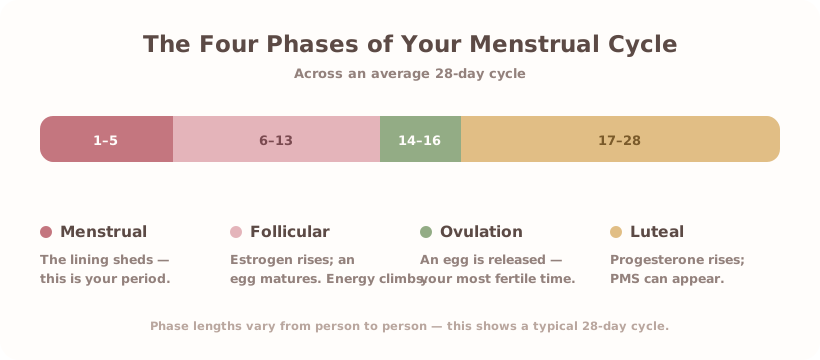
Beyond just predicting the next period date, this menstrual cycle calculator maps out your luteal phase, your next ovulation window, and your fertile days. Pair these results with our ovulation calculator for a complete picture of your reproductive cycle each month.
Quick Tips
Count from day 1 of bleeding, not when spotting starts
Day 1 of your menstrual cycle is the first day of full menstrual flow. Spotting the day before doesn't count. Getting this date right is the single biggest factor in how accurately a menstrual cycle calculator can predict your next period.
A normal menstrual cycle runs 21 to 35 days
The 28-day cycle is an average, not a standard. Cycles shorter than 21 days or longer than 35 days are considered irregular and worth discussing with a doctor. Cycles that vary by 5-7 days from month to month are common and generally normal.
Track 3 to 6 cycles to find your true average
One cycle length tells you very little. Tracking three to six consecutive menstrual cycles lets you calculate your actual average cycle length. That number is far more useful for predicting future menstrual periods than a single data point.
Stress, illness, and travel can shift your cycle
Major physical or emotional stress can delay ovulation, which pushes your period back. Long-haul travel across time zones has a similar effect. If your period arrives later than predicted, an external stressor is often the reason, not a calculator error.
Sources
- Abnormal Uterine Bleeding, American College of Obstetricians and Gynecologists (ACOG)
- Fertility Awareness-Based Methods of Family Planning, American College of Obstetricians and Gynecologists (ACOG)
- Your menstrual cycle, Office on Women's Health, U.S. Department of Health and Human Services
- Real-world menstrual cycle characteristics of more than 600,000 menstrual cycles, npj Digital Medicine (2019)
Menstrual Cycle Calculator FAQ
- A menstrual cycle calculator takes two pieces of information: the first day of your last period and your average cycle length. It adds your cycle length to your last period date to predict when your next period should start. For example, if your last period started on March 1st and your cycle is 28 days, the calculator predicts your next period around March 29th. Most menstrual cycle calculators also show several future cycles at once, so you can see dates weeks or months ahead. The math is straightforward, but accuracy depends on how consistent your cycle length is.
- To calculate your menstrual cycle length, count from day 1 of one period to day 1 of the next period. Do not count the number of days you bleed. Count the total days between the start of one period and the start of the following one. For example, if your period started on February 3rd and again on March 2nd, your cycle length is 27 days. For a more reliable number, track three to four cycles and average the lengths. Add them up and divide by the number of cycles you tracked.
- A normal menstrual cycle length ranges from 21 to 35 days, according to the American College of Obstetricians and Gynecologists. The widely cited 28-day cycle is a population average, not a standard every person should match. Cycles shorter than 21 days or longer than 35 days consistently are worth discussing with a healthcare provider. Cycle length can also change across your lifetime, particularly after starting or stopping hormonal contraception, after pregnancy, or approaching perimenopause.
- Yes. This irregular menstrual cycle calculator accepts any cycle length between 21 and 40 days. For irregular cycles that vary each month, find your average first. If your last four cycles were 27, 32, 29, and 30 days, your average is 29.5 days. Round to 30 and enter that. The menstrual cycle calculator for irregular periods will give you a reasonable estimate, though the actual date may shift by several days. If your cycle varies by more than 7 to 8 days each month, consider tracking with a period app alongside this calculator for better accuracy over time.
- For regular cycles, a menstrual cycle period calculator is usually close, though it cannot promise an exact day. Accuracy improves when you enter a precise average cycle length based on multiple tracked cycles. For irregular cycles, predictions are less reliable because the calculator cannot account for month-to-month variation. This online menstrual cycle calculator is best used as a planning guide, not a medical tool. If you need to confirm ovulation timing precisely, combine this calculator with ovulation predictor test strips.
- Start counting on day 1 of your menstrual cycle, which is the first day of full menstrual bleeding. Day 2 is the next day, day 3 the day after that, and so on. Your menstrual cycle ends on the day before your next period starts. That total number is your cycle length. For example, if your period started on the 5th and your next menstrual period started on the 2nd of the following month, count: 5th to end of month plus the 2nd. The key rule is always start your count on the first day of real menstrual bleeding, not spotting.
- Ovulation often happens about 12 to 16 days before your next period starts, though it can be shorter or longer. For a 28-day cycle, that's around day 14. For a 35-day cycle, ovulation falls closer to day 21. The second half of your cycle (from ovulation to your period) is more consistent in length than the first half. That's why longer cycles usually mean a longer follicular phase before ovulation, not a longer luteal phase after it. Use our ovulation calculator alongside this menstrual cycle calculator to see your estimated ovulation date.
- Several common reasons can push a period past the predicted date. Stress is a common cause: physical or emotional stress can delay ovulation, which delays your period. Illness, significant weight changes, intense exercise, or travel can have the same effect. Hormonal fluctuations, particularly around perimenopause, also cause menstrual cycles to lengthen or shorten unexpectedly. A late period after unprotected sex is worth testing with a pregnancy test. If your period is consistently later or earlier than the menstrual cycle calculator predicted, your average cycle length may need adjusting. Tracking several menstrual cycles in a row gives you a better baseline.
- The luteal phase is the second half of your menstrual cycle, from ovulation until your next period starts. It often lasts about 12 to 16 days, though it can be shorter or longer. Unlike the first half of your menstrual cycle, the luteal phase stays relatively consistent month to month. This consistency is what makes backward calculation from your expected period date a reasonable way to estimate ovulation. If you know your luteal phase length precisely (from temperature tracking or ovulation test strips), entering it into a menstrual cycle calculator gives you a more accurate ovulation date estimate for that menstrual cycle.
- Talk to a doctor if your menstrual cycle is consistently shorter than 21 days or longer than 35 days. Also seek advice if you bleed for more than 7 days per menstrual cycle, if periods are extremely heavy (soaking through a pad or tampon every hour for several hours), or if you suddenly skip periods without pregnancy as an explanation. Spotting between periods, severe cramping that interferes with daily life, or menstrual periods that stop for 3 months or more are also reasons to check in with a healthcare provider. A menstrual cycle calculator can help you track patterns and spot irregularities over time, but it doesn't replace a medical evaluation.
More Menstrual Cycle Calculator Tools
Keep exploring your cycle with these free tools.